A general contractor's monthly schedule updates are usually read once and filed. On a recent engagement, they were the entire case. An electrical subcontractor on a medical office building came to us with a familiar problem: their rough-in window had been cut by more than a third, the completion date never moved, and the GC was treating the compression as business as usual. The question was whether the schedule record supported a change order. It did — and the strongest evidence came from the GC's own submissions.
The pattern: a day-for-day mirror
The GC's framing and ceiling close-in work in the affected area slipped roughly 40 working days across four consecutive monthly updates. The GC's own narrative attributed the slippage to framing crew shortages and a reissued structural detail — both squarely within the GC's control.
Here is what made causation effectively self-proving: the electrical rough-in start moved 40 working days in the same updates, mirroring the framing slip day for day. The access lag between framing completion and rough-in start was identical — 11 working days — in the baseline and in every update that followed. The successor moved only because the predecessor moved. Not one update attributed any slippage to the electrical contractor.
When a trade's start date tracks its predecessor's completion across four consecutive updates with an unchanged lag, there is no argument about who caused the delay. The GC's own printed schedules carry it.
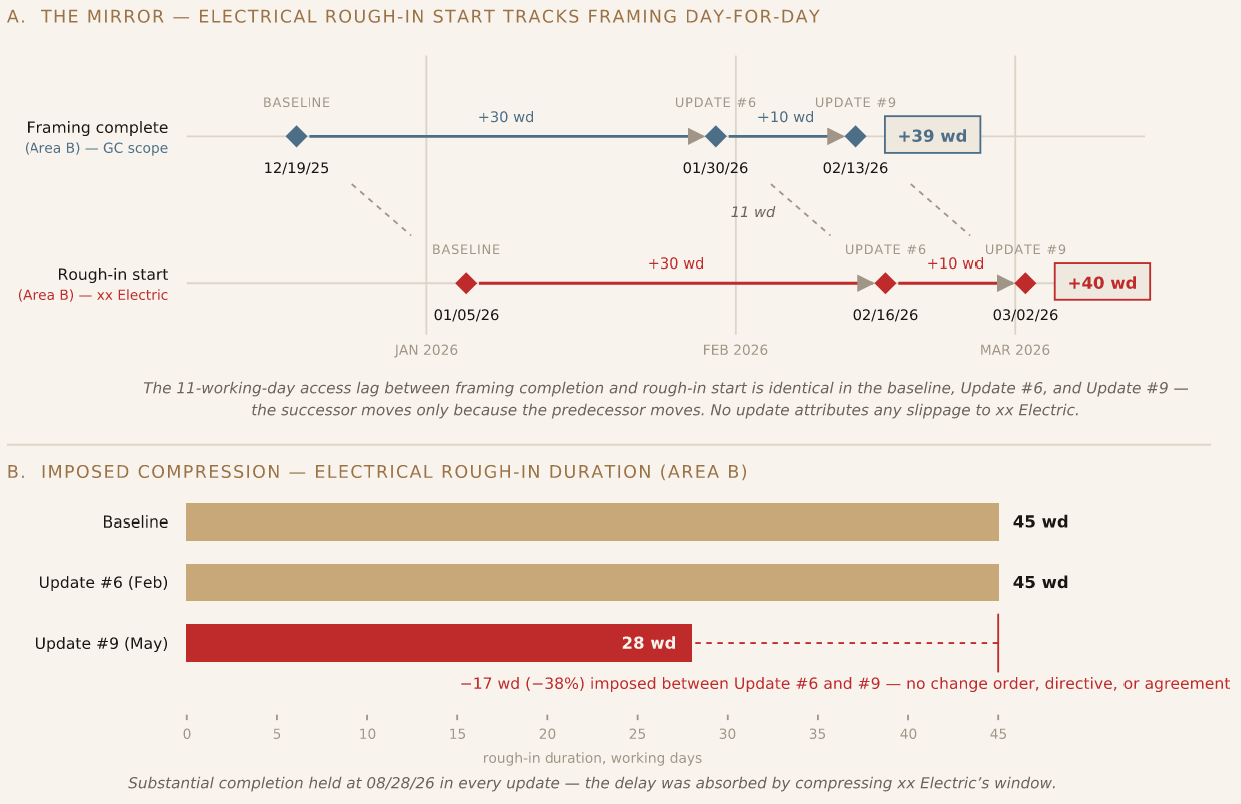
The compression: 45 days becomes 28, and the end date never moves
Between two updates, the GC cut the electrical rough-in duration from 45 working days to 28 — a 38% reduction — with no change order, no directive, and no documented agreement. Substantial completion held at the same date in every single update. The delay was never recovered; it was absorbed by shortening the window of a trade that didn't cause it.
That combination — predecessor slip, mirrored successor slip, held completion date, compressed successor duration — is the recognized fact pattern for constructive acceleration. The subcontractor had given timely written notice twice, requested a time extension, was directed to hold the date, and performed the compressed work. Every element was documented.
What the compression actually cost
Compression is not free. It shows up in the field as trade stacking, overtime, and wasted mobilizations, and each impact left a paper trail:
Eight additional weeks of field supervision and jobsite overhead from the displaced window. A measured-mile comparison against the contractor's own unimpacted production in an adjacent area supported a 14.5% productivity loss from working stacked with mechanical, plumbing, and fire protection in the same ceiling zones. Certified payroll showed six sustained weeks of 50-plus-hour weeks that no bid contemplated. Two aborted mobilizations — crews sent in per the GC's look-ahead, predecessor work incomplete, demobilized. Switchgear and feeder deliveries that arrived per the baseline procurement plan and had to be stored and double-handled when the installation window moved.
Assembled component by component against the schedule record, the change order request came to nearly $187,000 — conservatively structured, with every line tied to documentation the GC could audit.
A note on PDF-only reviews
The GC never provided native P6 files. The entire analysis was performed from PDF schedule submissions — printed dates, milestone movement, and month-over-month comparison. That is a real limitation: logic ties, constraints, calendars, and float values cannot be independently verified from a PDF. But the consistency of the pattern across six updates provided a sound basis for the opinions, and a forensic time impact analysis on the native files would be expected to strengthen the conclusions, not weaken them.
Two recommendations follow from that. First, if a GC disputes findings built on its own PDF submissions, the subcontractor should formally request the XER files — the native record either confirms the pattern or the GC explains why it won't produce it. Second, subcontractors should push for subcontract language requiring distribution of native schedule files, or at minimum longest-path and total-float layouts, with each monthly update. The trade that only ever sees a PDF Gantt chart is the trade that absorbs the compression.
What subcontractors should take from this
The entitlement case was won by contemporaneous discipline, not by after-the-fact analysis. The notice letters were sent on time. The daily reports captured the aborted mobilizations when they happened. Certified payroll documented the overtime as it was worked. The measured-mile baseline existed because the contractor's unimpacted production had been tracked. Our analysis organized the record — but the record had to exist first.
If your window is being compressed while the completion date holds, the schedule updates you receive every month are evidence. Read them. Compare them. Keep every version. When the predecessor slips and your start slips with it, day for day, the GC's own submissions are building your case — whether the GC realizes it or not.